Adaptive Gradient Matching Methods
These methods have been introduced in [1] to handle parameter inference in the very general class of nonlinear ODE models
The idea is to combine both the explicit relationship given by the function $f$, and a Gaussian process prior on the state variables. This leads to a pair of densities
and
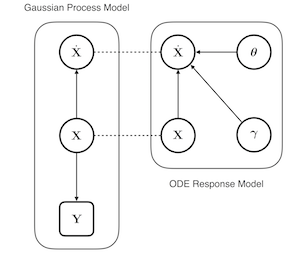
Figure Conceptual diagram of the product of experts approximation. The ODE model and the GP prior are combined by identifying the variables connected with the “- - - ” line by way of the product of experts assumption
For the MLFM AdapGrad model the likelihood of a set of state variables may be written
where \(\mathbf{f}_k\) is the vector of components of the evolution equation, the entries of which are given by
One interesting point from the perspective of identifiability of models of these types is that the likelihood-term will remain invariant under choices of \(\mathbf{g}, \boldsymbol{\beta}\) such that \(\mathbf{f}_k\) remains invariant.
All of the adative gradient matching methods proceed from this conditional density
Model Parameters
The following table gives the complete collection of variables that appear in the adaptive gradient matching method for the MLFM, along with a brief description of this variables, how this variable is referred to when using the package, along with transformation that i s applied to this variable to give it a more natural support.
| Parameter name | Description | Variable name | Transform | Is Fixed |
| \(\mathbf{g}\) | The (vectorised) latent GPs | g |
\(\mathrm{Id}\) | False |
| \(\boldsymbol{\psi}\) | latent GP hyperparameters | logpsi |
\(\log\) | False |
| \(\boldsymbol{\beta}\) | Basis coefficients | beta |
\(\mathrm{Id}\) | False |
| \(\boldsymbol{\tau}\) | Observation precisions | logtau |
\(\log\) | False |
| \(\boldsymbol{\gamma}\) | ODE model regularisation | loggamma |
\(\log\) | True |
MAP Estimation
The following list of notebooks give an introduction to fitting these models using the adaptive gradient matching approximation, as well as a discussion of some of the more general features of the MLFM model