Note
Click here to download the full example code
Basic MAP Estimation
This note descibes how to carry out the process of carrying out MAP
parameter estimation for the MLFM using the Adaptive Gradient matching
approximation. This uses the MLFMAdapGrad object and so our
first step is to import this object.
import numpy as np
import matplotlib.pyplot as plt
from scipy.integrate import odeint
from pydygp.linlatentforcemodels import MLFMAdapGrad
from sklearn.gaussian_process.kernels import RBF
np.random.seed(17)
Model Setup
To begin we are going to demonstate the model with an ODE on the unit sphere
which is given by the initial value problem
where the coefficient matrix, \(\mathbf{A}(t)\), is supported on the Lie algebra \(\mathfrak{so}(3)\). We do this by representing the
where \(\{\mathbf{L}_d \}\) is a basis of the Lie algebra
\(\mathfrak{so}(3)\). The so object returns a tuple
of basis elements for the Lie algebra, so for our example we will
be interested in so(3)
from pydygp.liealgebras import so
for d, item in enumerate(so(3)):
    print(''.join(('\n', 'L{}'.format(d+1))))
    print(item)
Out:
L1
[[ 0.  0.  0.]
 [ 0.  0. -1.]
 [ 0.  1.  0.]]

L2
[[ 0.  0.  1.]
 [ 0.  0.  0.]
 [-1.  0.  0.]]

L3
[[ 0. -1.  0.]
 [ 1.  0.  0.]
 [ 0.  0.  0.]]
Simulation
To simulate from the model we need to chose the set of coefficients \(\beta_{r, d}\). We will consider the model with a single latent forcing function, and randomly generate the variables \(beta\)
pydygp.linlatentforcemodels.MLFMAdapGrad.sim()
g = lambda t: np.exp(-(t-2)**2) * np.cos(t)  # single latent force
beta = np.random.randn(2, 3)

A = [sum(brd*Ld for brd, Ld in zip(br, so(3)))
     for br in beta]

ttd = np.linspace(0., 5., 100)
x0 = [1., 0., 0.]
sol = odeint(lambda x, t: (A[0] + g(t)*A[1]).dot(x),
             x0,
             ttd)
The MLFM Class
mlfm = MLFMAdapGrad(so(3), R=1, lf_kernels=(RBF(), ))

x0 = np.eye(3)

# downsample the dense time vector
tt = ttd[::10]
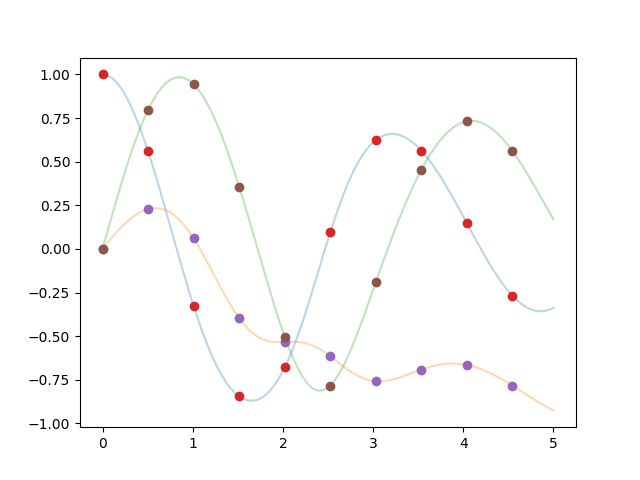
Data, _ = mlfm.sim(x0, tt, beta=beta, latent_forces=(g, ), size=3)

fig, ax = plt.subplots()
ax.plot(ttd, sol, '-', alpha=0.3)
ax.plot(tt, Data[0], 'o')
Latent Force Estimation
Y = np.column_stack(y.T.ravel() for y in Data)
res = mlfm.fit(tt, Y, beta0 = beta, beta_is_fixed=True)

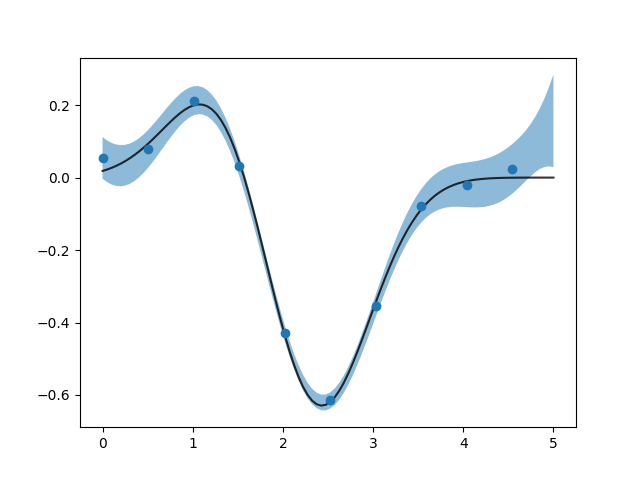
# predict the lf using the Laplace approximation
Eg, SDg = mlfm.predict_lf(ttd, return_std=True)

# sphinx_gallery_thumbnail_number = 2
fig2, ax = plt.subplots()
ax.plot(ttd, g(ttd), 'k-', alpha=0.8)
ax.plot(tt, res.g.T, 'o')
for Egr, SDgr in zip(Eg, SDg):
    ax.fill_between(ttd,
                    Egr + 2*SDgr, Egr - 2*SDgr,
                    alpha=0.5)

plt.show()
Total running time of the script: ( 0 minutes 2.091 seconds)